
Home Workouts
Strength Exercises for Older Adults at Home: The NHS Chair and Wall Routine
Nov
Strength exercises for older adults can be done at home with nothing more than a sturdy chair, a wall and a couple of filled water bottles. The NHS publishes a routine of seven gentle strength exercises designed for home use, and its guidelines for adults aged 65 and over ask for activities that improve strength, balance and flexibility on at least 2 days a week. This guide works through the questions that come up when setting the routine up at home.
Is the routine suitable for someone who has not exercised in years?
The NHS describes these strength exercises as gentle and easy to follow, and says not to worry if you have not done much for a while. Its guidelines for older adults add a caution: speak to a GP first if you have not exercised for some time, or if you have medical conditions or concerns, and make sure the activity and its intensity are appropriate for your fitness.
The practical preparation is short. The NHS suggests loose, comfortable clothing and some water kept handy, and advises building up slowly, aiming to increase the repetitions of each exercise gradually over time.
What kind of chair does it need?
Five of the seven moves use the chair, either to sit on or to hold for stability. The NHS sets out what to look for:
- solid and stable, with no wheels
- will not slip on the floor surface it stands on
- a height that lets you sit with your feet flat on the floor and your knees bent at right angles
- no arms, as these restrict movement
The site’s guide to seated home workouts and equipment options covers chair choice in more depth.
Which moves are in the NHS routine?
The NHS strength routine has seven exercises. The amounts below are the starting points its page gives.
| Exercise | What it involves | Amount |
|---|---|---|
| Sit-to-stand | From the edge of the chair, stand up slowly using the legs rather than the arms, then sit down slowly | 5 repetitions; the NHS says the slower, the better |
| Mini-squats | Hands on the chair back, bend the knees as far as is comfortable with the back straight | 5 times |
| Calf raises | Hands on the chair back, lift both heels slowly | 5 times |
| Sideways leg lift | Hands on the chair back, raise each leg to the side without tilting | 5 times each leg |
| Leg extension | Hands on the chair back, raise each straight leg backwards without arching the back | Hold up to 5 seconds, 5 times each leg |
| Wall press-up | Hands flat on a wall at chest height, arms’ length away, bend the arms with elbows by the sides | 3 sets of 5 to 10 repetitions |
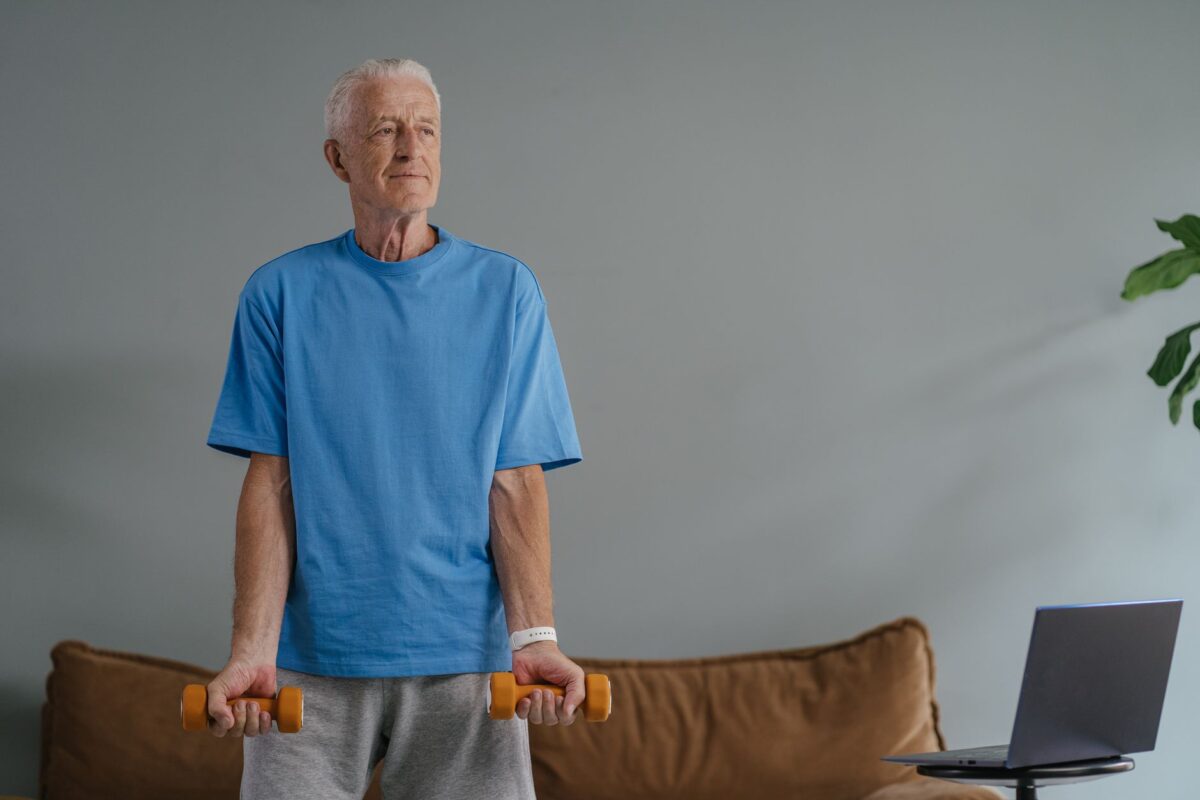
| Biceps curls | Light weights held at the sides, bend the arms to bring them to the shoulders | 3 sets of 5 curls each arm |
The page also gives two variations: calf raises can be made more difficult by doing them without support, and biceps curls can also be done sitting down.
What else has to be in the room?
Beyond the chair, the routine asks for very little:
- A clear section of wall to stand at arm’s length from, for the wall press-up.
- Light weights. The NHS notes that filled water bottles will do for the biceps curls.
- Room around the chair for the sideways leg lift and the leg extension, which move each leg to the side and backwards.
The NHS page does not specify a mat or flooring. Keeping the area free of rugs and cables is covered in planning an accessible space for older adults.
How often, and how hard?
The NHS asks for these exercises at least twice a week. Its older adults’ guidance explains how hard strength work should feel to be worthwhile: to get health benefits, strength exercises should be done to the point where you need a short rest before repeating the activity.
The full weekly guidelines for adults aged 65 and over are to:
- be physically active every day, even if it is just light activity
- do activities that improve strength, balance and flexibility on at least 2 days a week
- do at least 150 minutes of moderate intensity activity a week, or 75 minutes of vigorous intensity activity if already active, or a combination of both
- reduce time spent sitting or lying down and break up long periods of not moving with some activity
The NHS points out that muscle-strengthening exercises are not always aerobic, so they are needed in addition to the 150 minutes. Strength work can be done on the same day as aerobic activity or on a different one, whichever suits. For anyone who has fallen or is worried about falling, the guidance says exercises that improve strength, balance and flexibility will help make them stronger and feel more confident on their feet.
Can it be combined with other NHS routines?
The strength page is one of a series, and the NHS suggests combining it with its sitting, flexibility and balance exercises. The flexibility routine is short: a neck rotation and a neck stretch done sitting upright, a sideways bend standing with feet hip-width apart, and a calf stretch with hands against a wall. Like the strength moves, the NHS suggests doing these at least twice a week.
The balance routine, which uses the same wall and chair, is set out in balance exercises at home. A separate NHS programme of how-to videos is covered in NHS Strength and Flex at home.
The bottom line
The NHS home strength routine for older adults is seven moves: sit-to-stand, mini-squats, calf raises, sideways leg lifts, leg extensions, wall press-ups and biceps curls. It needs a stable chair without wheels or arms, a clear wall and light weights such as filled water bottles. The NHS suggests doing it at least twice a week, building up repetitions slowly, and speaking to a GP first after a long break from exercise or with any health concerns.
Sources
- Strength exercises, NHS, page last reviewed 28 February 2024 (nhs.uk)
- Physical activity guidelines for older adults, NHS, page last reviewed 15 August 2024 (nhs.uk)
- Flexibility exercises, NHS, page last reviewed 20 November 2023 (nhs.uk)
